

Egyptian National Observatory For Women
Data is being prepared for your service...
Please wait while we prepare the insights and reports
Preparing......
Vision 2030POWERED BY BASEERA
Please wait while we prepare the insights and reports
POWERED BY BASEERA
Explore the latest reports and publications related to Egyptian women's empowerment.
 Baseera
After the launch of Egypt National Strategy for Woman's Empowerment 2023, and with the urgent need for a mechanism to monitor the implementation of the strategy, The Egyptian Center for Public Opinion Research (Baseera) proposed the idea of establishing the "Egypt National Observatory for Woman." The initial idea of the observatory included monitoring indicators for following up on the implementation of the four pillars of the national strategy for women's empowerment based on available data. The Observatory's purpose then expanded to include bridging the data gap related to the empowerment of Egyptian woman, especially that data related to values and social norms, through surveys and opinion polls.
 Baseera
Women’s labor force participation and employment rates in Egypt have recovered somewhat in recent years after declining for several years and reaching a low during the COVID-19 pandemic. Some sectors of economic activity are seeing both higher than average employment growth and faster growth for women than for men. These include wholesale and retail trade, accommodation and food services, information and communications, health and social work, manufacturing, and other services, which comprise real estate, professional, technical, administrative, entertainment, and personal services. These sectors offer good prospects for future growth of women’s employment if Egypt’s development trajectory is able to increasingly favor these sectors.
 Baseera
Within the framework of the activities of the Egypt National Observatory for Women (ENOW), that are conducted in cooperation between the National Council for Women, the World Bank, and Baseera Center, a report on “Social Norms and Female Labor Force Participation in Egypt” was launched. The study of social norms stems from the interest of the Egyptian state in confronting the negative values that are unfavorable to the empowerment of women, as Egypt National Strategy for Women Empowerment emphasized the importance of changing the culture of society towards women. The strategy also pointed to the gap between the academic excellence of Egyptian women and their absence from participating in economic activity. The strategy attributed that to the ruling system of values that constitute an obstacle to women's economic empowerment. Overall, the study showed results that can be used in the design of media and awareness interventions (including media messages, television drama, and messages on social media). This includes reconsidering some of the prevailing constants, re-prioritizing work in the field of enlightenment, designing interventions and messages that distinguish between social segments and designing interventions and messages for all segments of society. Link to the full report in English: https://documents.worldbank.org/en/publication/documents-reports/documentdetail/099061823220039155/p17968608f6dd00350b350081904da12d91
 Baseera
What has Egypt national Strategy for Women Empowerment achieved in 7 years? Political empowerment Economic empowerment Social empowerment Protection
 Baseera
The Objective of the GGG simulator is to provide a simulation of the Global Gender Gap index in, as it calculates the overall index and Egypt's ranking based on any changes that occur to the indicators calculated from it. The Simulator help decision makers to prioritize the interventions to be made to maximize the improvement in Egypt's rank in the GGG.
 Baseera
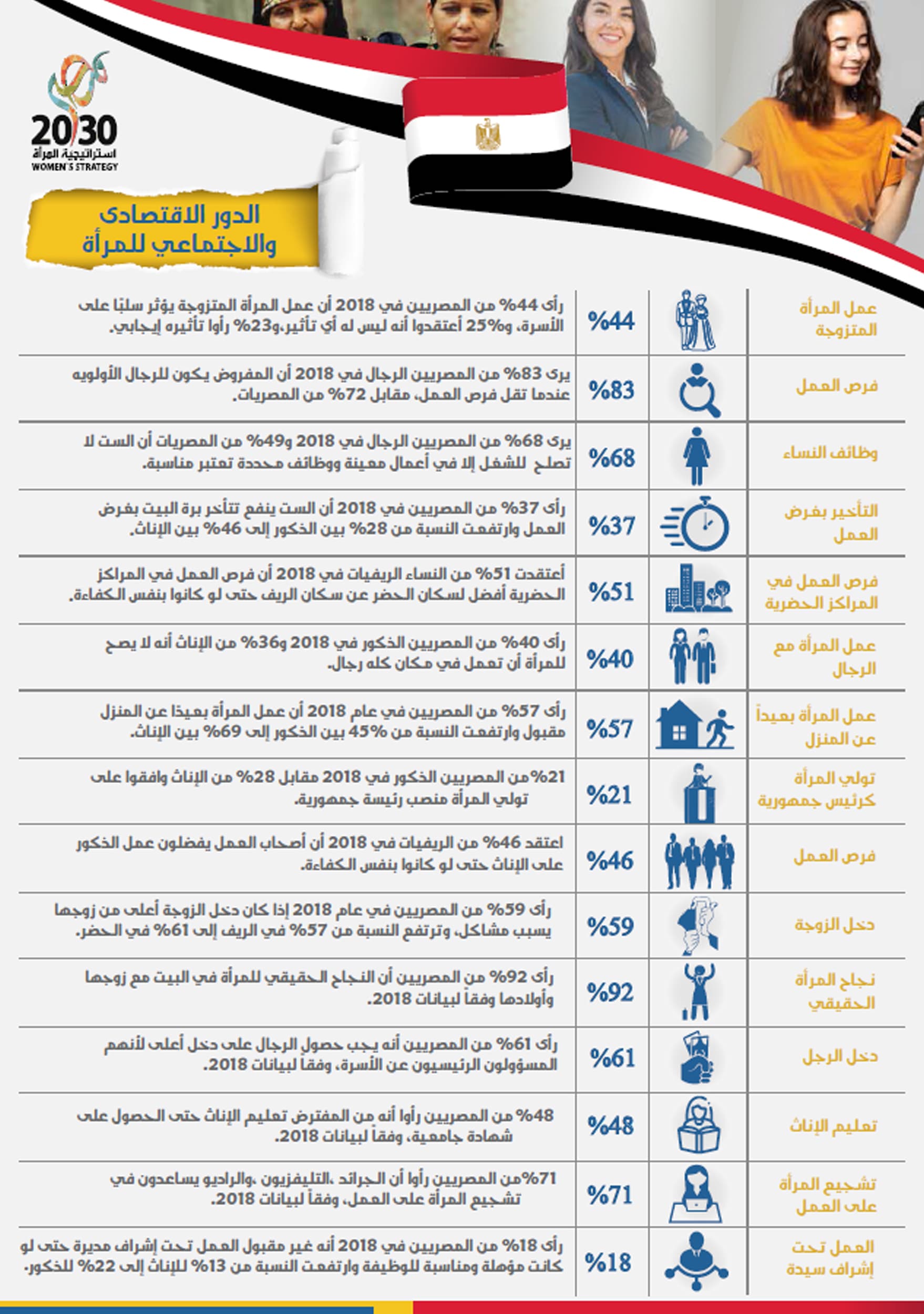
On the occasion of Women's Month, Baseera center issued a bulletin containing the most important figures related to the Perceptions of Egyptians about the economic and social role of women. The bulletin included the statistics that were published through the “Number of the day” service, under the umbrella of the Egypt National Observatory for Women (ENOW) project, which is implemented in cooperation with the National Council for Women and the World Bank. The following are the most important numbers included in the bulletin: 44% of Egyptians in 2018 viewed that married-woman's work negatively impacts families, 25% believed it has no effect, and 23% viewed it positive. 83% of Egyptian men in 2018 believed that men should be given priority when there are limited employment opportunities, compared to 72% of women. 68% of Egyptian men vs 49% of women in 2018 believed that women should be allowed to work only in specific jobs deemed appropriate. 37% of Egyptians in 2018 thought that it's acceptable for women to stay late at work, the percentage rose from 28% among males to 46% among females. 51% of rural women believed in 2018 that employment opportunities in urban centers are better for urban residents than rural even if they are equally qualified. 40% of Egyptians men in 2018 found it unacceptable for a women's workplace to be full of male colleagues, comapred to 36% of women. 57% of Egyptian in 2018 thought that women working far from home as socially acceptable, the percentage increased from 45% among males to 69% among females. 21% of Egyptian men and 28% of women in 2018 approved having a female president. 46% of rural women believed in 2018 that employers prefer male labor to female labor even if they are equally qualified. 59% of Egyptians believed in 2018 if a wife's income is more will cause problem, the percentage increased from 57% in rural areas to 61% in urban areas. 92% of Egyptians believed that woman's true success is at home with her kids, according to 2018 data. 61% of Egyptians believed that men should get higher because they are the main responsible for the family, according to 2018 data. 48% of Egyptians believed A that females should be educated until they obtain a university degree, according to 2018 data. 71% of Egyptians said that newspapers, TV, and radio help encourage women to work, according to 2018 data. 18% of Egyptians in 2018 found it unacceptable to work under a female supervisor even if she is qualified and appropriate for the position, the percentage rose from 13% among females to 22% among males. Only 8% of Egyptians in 2018 were working under a female supervisor and 55% under a male supervisor. 39% of Egyptian women in 2018 preferred a female supervisor compared to 7% of men. 36% of women in Egypt in 2018 were indifferent to gender of supervisor compared to 41% of men. 34% of Egyptian men and 27% of women in 2020 refused hiring caregivers for elderly parents even if the respondent is unable to care for the elderly themselves. 36% of Egyptian men in 2020 considered women who send their children to nurseries as negligent, compared to 31% of women. 97% of Egyptians who live in families with children refused to rely on child care providers, according to 2020 data. 80% of Egyptians believed that it is a shame that their father or mother enters a nursing home for the elderly, according to 2018 data. 46% of Egyptians thought that people who work in childcare cannot be trusted according to 2020 data. 86% of Egyptians believed that working women should have different work hours after childbirth, according to 2018 data. 71% of Egyptians said that having a suitable person to take care of their children could make them change the nature of their work, according to 2020 data. 34% of Egyptian males said that women's work at home is considered work that should be paid, compared to 27% of females, according to 2018 data. 30% of Egyptian men in 2018 and 22% of women believed that only competence should be a factor in determining salaries for the same position at the same place and not gender. 35% of Egyptian males and 50% of females believed that if the wife has an income, she should participate in the basic expenses of the house, according to 2018 data. 20% of rural women's households in Egypt in 2018 owned agriculture land; among which 34% of women at least sometimes work in this land. 82% of Egyptians refused to marry their daughters without a list of furniture "Qayma" and the refusal was higher in rural areas (88%) compared to urban areas (73%), according to 2018 data. More statistics and policy papers on the social and economic role of women can be obtained through “Egypt National Observatory for Women” portal www.enow.gov.eg .
 Baseera
Technology is bringing opportunity, paving the way to create new jobs, increasing productivity, and improving public service delivery. The 2019 World Development Report: The Changing Nature of Work by the World Bank shows that people in developed countries are optimistic about the benefits from technology to the workplace and quality of life however, they remain anxious about its sweeping impact on employment. Manufacturing jobs will be lost to automation in advanced and some middle-income countries, as well as routine and "codifiable" tasks which make a large spectrum of vulnerable workers. It is estimated that by 2030, due to automation up to 375 million workers may need to switch occupational categories globally, and 72 million workers may need to switch in developing countries.
 Baseera
Egypt has a young population. As per the data of 2017 census, 37.9 million in Egypt are less than 18 represents 40% of the Egyptian population. The number of children less than 12 is estimated at 28.9 million and is expected to reach 31.8 million in 2030. The unpaid care1 for families reflects gender inequality as most of these care activities are done by females. The latest statistics of the time use in Egypt in 2015 shows that unpaid housework accounted for 70% of the total value of unpaid work, while child and elderly care take around 26% of total value of unpaid work which equivalent to 170 billion EGP. Around 82% of the value of the child and elderly care activities are done by females. The following table show the unpaid work distribution between males and females in terms of monetary value.
 Baseera
Most of the responsibility for caring for family members, especially children, the elderly and the disabled, falls on the shoulders of women. Providing alternatives to provide care services to family members who need it is one of the means to reduce the burden on women, which allows them to participate in the labor force on the one hand, and on the other hand work in care services can provide job opportunities for women. This paper is part of a series on the care economy in an attempt to frame the role of the care economy vis-à-vis female labor force participation, while looking at the opportunities from both the supply and demand sides., This paper focuses on elderly care, while the others look at the childcare, and the care for the disables.
 Baseera
Women participation in the labor market can be hampered by their frequent engagement in unpaid care. Globally, they do three times more of the world’s unpaid work than men. This outcome is not destiny. On the contrary, economic policies that recognize, reduce and redistribute unpaid work could increase their participation in the labor force, promote sustained economic growth, and advance gender equality. The challenge is how to measure the extent of the burden and benefits of unpaid care work, and to identify its causes so as to take the necessary actions. Exacerbating this challenge further is that social norms usually assign unpaid work exclusively to women, which means that change would require a cultural transformation, in addition to removing the prevailing structural barriers to women’s labor force participation.
 Baseera
The economic empowerment of women is a main pillar of the Egypt National Strategy for Women’s Empowerment 20301, which sets out several mechanisms to achieve this goal. These include a) expanding employment options; b) increasing Female Labour Force Participation (FLFP); c) providing equal opportunities in all sectors (including entrepreneurship and the private sector); and d) assumption of key positions by women in both public sector and private entities. Concurrently, the strategy aims to guarantee opportunities for greater social participation of women, expand capacities of choice, and work towards the eradication of practices that are discriminative and harmful against women within the family and in the public sphere. This paper aims to envision the future of economic empowerment of Egyptian women in light of the COVID-19 pandemic.
 Baseera
Egypt’s vision for 2030 is to achieve a sustainable inclusive growth and development without leaving anyone behind with focus on achieving social integration systematically in order to narrow gender gaps and achieve equal opportunities and rights. Egypt National Strategy for Women Empowerment 2030 was initiated by the National Council for Women through a wide community dialogue with all stakeholders. The strategy was launched in 2017 with targets that are fully aligned with the targets of the SDS and the international sustainable development goals (SDGs) declared by the United Nations for 2030. The goal of the second pillar of the NCW strategy is to develop women’s capacity to enhance their employment options, expand their participation in the workforce, support their entrepreneurship, and realize equal opportunities for women’s employment in all sectors, including holding senior positions in both the public and private sector.